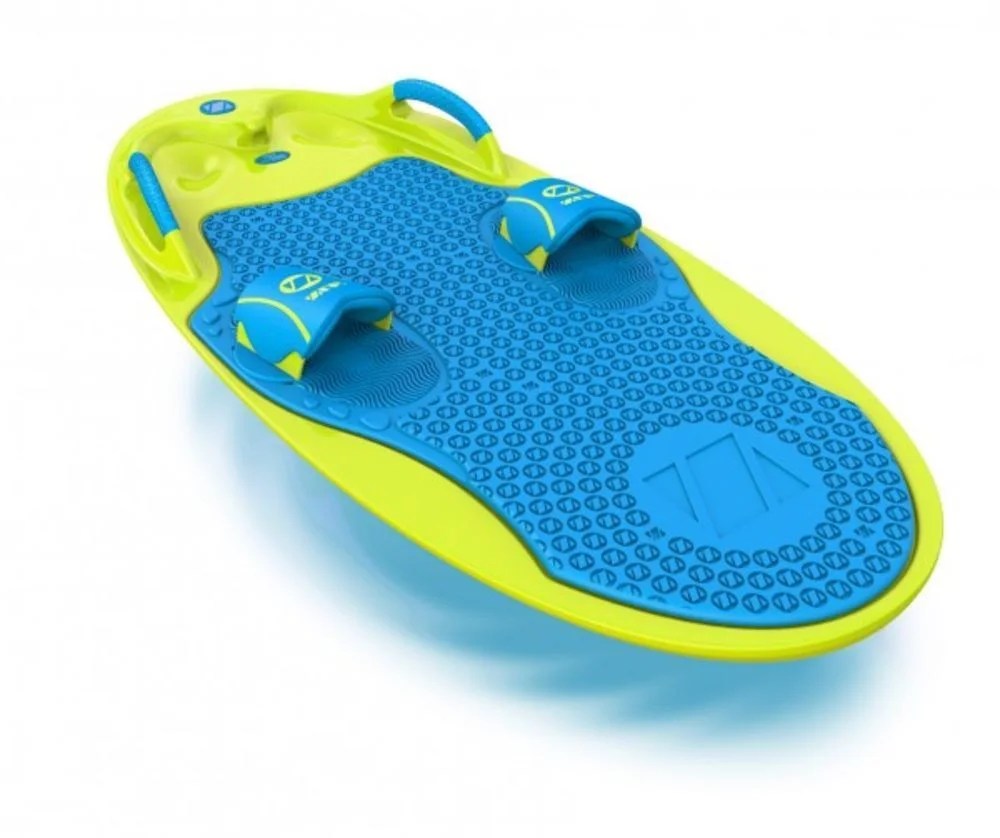
Having fun on something behind the wake of a power boat has made many smiles. Whether it is a knee-board, water ski, or foil board, there is just something awesome about the feeling.
While Nash has been a dominant player in the market for years, start-ups are moving in. ZUP makes a multi-purpose board that has been quite popular in that it makes it easier for those with less skill and balance to actually get up on the board and enjoy the fun. ZUP also has been proactive in obtaining, and attempting to enforce, patents on their innovations.

One of ZUP’s patents was 8,292,861 (see figure below), protecting an aspect of their ZUP board.

The independent claims of ZUP’s patent essentially protected the combination of the following elements (at least according to the Federal Circuit): (1) a riding board; (2) a tow hook on the front of the riding board; (3) a plurality of rails on the bottom surface of the riding board; (4) side -by-side handles on the front of the riding board; (5) side -by-side foot bindings on the middle of the riding board; and, at least as stated in claim 1, (6) the ability to simultaneously engage the handles and foot bindings to position the rider in a crouching stance.
Nash, likely seeing the ZUP board, came out with a similar looking design, shown below.

ZUP sued Nash for patent infringement, but unfortunately (for ZUP) the court found the patents obvious. The problem seems to have been, for ZUP, that all of the claimed elements were known in the art, just not in the combination as done by ZUP. Under the current interpretation of obviousness law, ZUP had a tough case because, in hindsight, it almost always seems obvious to re-arrange parts and combine features from various devices to reach the invention. According to the court, one of ordinary skill in the art would have been motivated to combine the various elements from the prior art references, noting that such motivation would have stemmed from a desire “to aid in rider stability, to allow a wide variety of users to enjoy the device, and to aid users in maneuvering between positions on a water board” — all motivations that were “a driving force throughout the prior art and have been shared by many inventors in the water recreational device industry.”
The question that is always difficult to answer for those alleging obviousness is – if it was so obvious, why didn’t anyone every do it? There was clearly a market, which ZUP proved. But alas, that is that difficulty in analyzing obviousness.
So, what could ZUP have done? One issue to note is how similar the products actually appear, leading one to wonder whether a design patent might not have come in handy in this case.

 Mr. IP Law
Leave a reply to Glen Wade Duff Cancel reply