
Patent law has a reputation, not entirely undeserved, for turning simple questions into elaborate ones. Some of that complexity is real and necessary. Claim construction is a legal exercise, not a plain-English reading contest, and structural claim terms in particular carry doctrinal baggage that a layperson would never anticipate. The Manual of Patent Examining Procedure reminds examiners that apparatus claims cover what a device is, not what it does, which means an old structure capable of a new use is still the same old structure for anticipation purposes. That single principle generates a surprising amount of downstream argument about what a claim term actually requires structurally, as opposed to what the inventor merely hoped the structure would accomplish.
At the same time, the governing standard for interpreting claims during examination is not the broadest conceivable interpretation. It is the broadest reasonable interpretation consistent with the specification, construed the way a person of ordinary skill in the art would construe it. That qualifier is supposed to do real work. It is supposed to prevent an examiner, or an appellant, from stretching a claim term so far past its ordinary meaning that the analysis stops resembling patent law and starts resembling a philosophy seminar. In practice, that qualifier does not always do its job, and prosecution can drift into a kind of manufactured complexity where a case that should turn on one plain question instead turns on several pages of strained argument.
A recent decision from the Patent Trial and Appeal Board, Ex parte Giorno, Appeal 2026-000851 (PTAB 2026), is a useful illustration of both phenomena. The application, Serial No. 16/958,783, is directed to an off-angle screw engagement system. The rejection of claim 1 on appeal was straightforward on its face: anticipation on a single prior art reference, Taubert (U.S. Patent No. 4,824,418, “Articulated Joint Between Two Shafts,” issued April 25, 1989). What makes the case worth discussing is not the outcome so much as how much argumentative machinery the Examiner built around a single word: “screw.”
Claim 1 of the application recites, in relevant part:
- A screw engagement system for transmission of torque
and rotational motion from a screw driver to a screw, the system
comprising:
a screw comprising a screw shaft axially extending from a
screw head, and a screw head recess formed axially into the
screw head from an end surface of the screw head, the screw head
recess including a plurality of screw head recess grooves
arranged circumferentially around and formed radially
outwardly into the screw head from an inner circumferential
surface of the screw head recess; and
a driver comprising a driver head having the shape of a
grooved spherical frustum and including a plurality of splines
that are defined by driver head grooves formed into and arrayed
circumferentially around the driver head, and that are configured
to engage the screw head recess grooves and transmit torque and
impart rotational motion to the screw therethrough, each spline
of the plurality of splines having an outer surface extending
circumferentially between corners formed with adjacent grooves
of the circumferentially-arrayed driver head grooves.
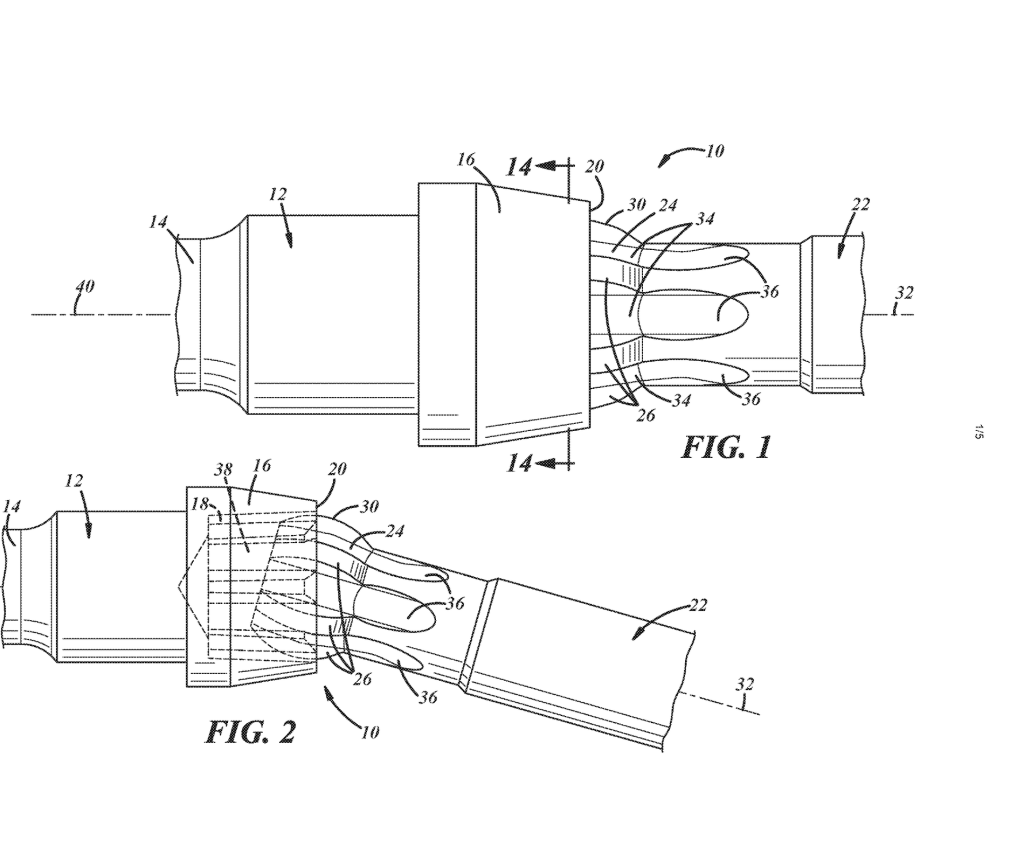
The point of the invention, as described in the specification, is to allow reliable torque transmission at an angle of up to roughly 165 degrees between the driver’s rotational axis and the screw’s rotational axis, which is useful, among other places, in orthopedic and dental bone screw applications where a straight approach to the screw head is not always available.
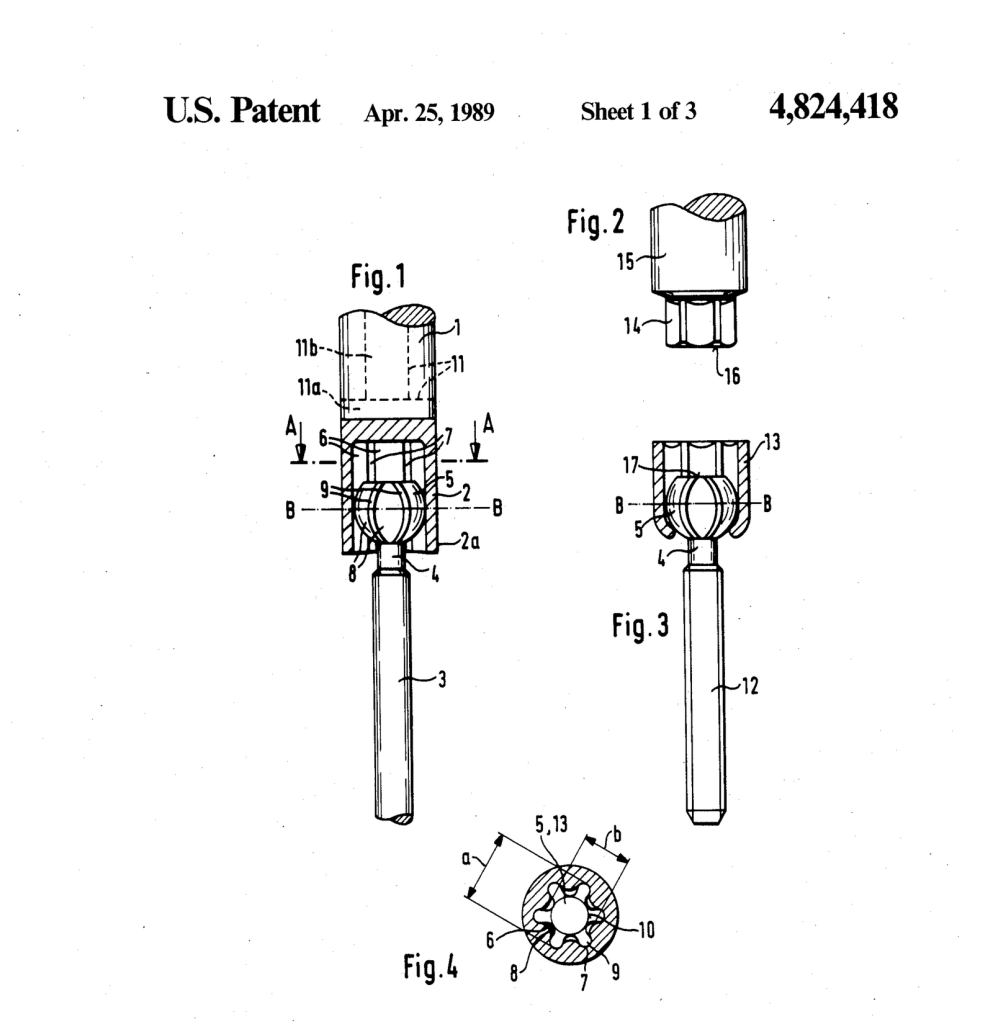
The Examiner rejected claim 1 as anticipated by Taubert, which discloses an articulated joint used to couple two shafts that pivot with respect to one another, commercially associated with TORX-style drive geometry. Taubert’s Figure 1 shows a hollow, cylindrical drive element (element 2) with wavy internal grooves, connected to a spherical drive element (element 5) at the end of a second shaft. Above element 2, and separately numbered, Taubert discloses an actual screw, made up of a screw head (11a) and a screw shank (11b), which can be received within element 2’s shaft.
The problem for the rejection was that Taubert’s own numbering keeps the screw (11a/11b) and the hollow drive element (2) as distinct parts, and the specification never states that they form a single component. Taubert’s hollow drive element does not fasten anything; functionally, it is closer to an adapter that drives a separate screw than to a screw itself. To get around this, the Examiner asserted that because Taubert describes the screw head as connectable to the screw shank on the hollow drive element, the two were disclosed “connected as one item,” and the rejection further reached across to Figure 3 of Taubert, an admittedly different embodiment, to borrow structural features from an unrelated hollow cylinder (element 13) that Taubert never described as sharing an embodiment with element 2.
The Examiner made a similar move on the claimed “grooved spherical frustum” driver head shape. Taubert refers to its own driver as a “spherical drive element,” and the Examiner leaned on that label alone to establish the claimed sphere-like geometry, notwithstanding that Taubert’s own specification describes the same element’s profile, in the applicant’s words, as inherently comprising no portion of an actual sphere. When the applicant pointed out that the claimed “corners” between the driver’s splines and grooves had no analog in Taubert’s smoothly wavy profile, the Examiner invoked the fifth dictionary definition of “corner,” a metaphorical usage referring to “a point at which significant change occurs,” normally reserved for phrases like “turning the corner” in a business or personal sense, to argue that Taubert’s profile had corners after all.
The Board did not need most of this. Rather than wading through the Examiner’s layered theory of “as one item” connections between distinct embodiments, or engaging with a dictionary definition of “corner” designed for boardroom pep talks rather than machined parts, the Board went back to basics. Anticipation requires that a single prior art reference disclose every claimed element, arranged as recited in the claim, and the burden of establishing that disclosure by a preponderance of the evidence rests with the Examiner. Claims cannot be reduced to “mere catalogs of separate parts,” divorced from the part-to-part relationships that give the claim its meaning, see Lindemann Maschinenfabrik GMBH v. American Hoist & Derrick Co., 730 F.2d 1452, 1459 (Fed. Cir. 1984). An examiner cannot borrow one part from one embodiment and a second part from an entirely different embodiment and declare the combination anticipatory.
Applying that framework, the Board found that Taubert’s hollow drive element 2 simply is not a screw under any reasonable reading of the word, ordinary dictionary definitions included, because it does not fasten anything. The reference’s actual screw, elements 11a and 11b, is never shown or described with the claimed head recess or grooves. And Taubert’s own textual description of drive element 5 as “spherical” did not overcome the reference’s own figures and specification language describing that same element’s profile as wavy, with no disclosed portion that is actually spherical. The Board likewise rejected the notion that the fifth, metaphorical dictionary definition of “corner” was a reasonable construction in a claim describing physical machined structure. On every disputed point, the Board’s reasoning was terse and grounded in the plain words of the claim, the plain disclosure of the reference, and the ordinary meaning a person of skill would bring to both. The rejection was thus reversed.
It would be easy to treat this case as an outlier, an Examiner who overreached and got corrected. But the pattern is familiar to anyone who prosecutes applications regularly. Once an Examiner adopts a position and defends it through one or more Office Actions, there is a natural institutional pull toward reinforcing that position rather than revisiting it, and the arguments used to reinforce it tend to get more elaborate, not less, as the record grows. A merger of two embodiments becomes “connected as one item.” A profile that the reference itself calls “wavy” becomes “spherical” by force of a single adjective used elsewhere in the specification. A dictionary’s fifth, clearly metaphorical definition becomes the broadest reasonable interpretation. A “screw” is anything that has any part of a typical screw. None of these moves is irrational in isolation, and each is often defended with genuine sincerity. But stacked together, they represent exactly the kind of manufactured complexity that the “reasonable” half of “broadest reasonable interpretation” is supposed to prevent.
This is also where the genuine nuance in patent law and the unnecessary complexity in patent law can look deceptively similar from a distance. It is entirely legitimate, and sometimes decisive, to argue about whether a claimed structure is defined by what it is versus what it does, or whether a term should carry its ordinary meaning versus a special definition supplied by the specification. Those are real doctrines with real teeth. What is not legitimate is using the vocabulary of claim construction to dress up an interpretation that no person of ordinary skill in the art, and frankly no ordinary English speaker, would actually reach. The Board’s decision did not require an elaborate opinion because the underlying question was not actually complicated. Once the layered assumptions were stripped away, the reference simply did not disclose a screw with the claimed features, and no amount of cross-embodiment borrowing or dictionary mining could change that.
For prosecutors watching a rejection accumulate this kind of interpretive scaffolding, a few lessons are worth keeping in mind. First, when an Examiner needs to combine structure from two different disclosed embodiments to complete a rejection, and the reference itself never describes those embodiments as sharing components, that gap is worth naming directly. Second, dictionary definitions cut both ways, and an Examiner’s selection of an unusual or metaphorical definition to rescue a rejection is often a sign that the more natural definition does not work. Pointing that out plainly, as the applicant did here, tends to resonate with a panel that is reading the claim fresh. Third, and perhaps most importantly, when a rejection has calcified over multiple Office Actions and an Examiner has invested significant effort defending an increasingly elaborate position, an appeal to the Board can be the most efficient path forward, not because the Board applies different law, but because it applies the same law without the accumulated institutional commitment to the existing rejection.
Patent law will always have real nuance. Structural claiming, means-plus-function analysis, and the many doctrines built up around functional language are not going anywhere, and they deserve careful treatment. But not every dispute needs that treatment, and prosecutors do their clients a service by recognizing when a case has drifted from genuine doctrinal complexity into manufactured complexity. Sometimes a screw is just a screw, and saying so, plainly and early, is the better use of everyone’s time.


Leave a Reply